| L | A | n | Deaths (Y=1) | Pr[Y=1 | A, L] |
|---|---|---|---|---|
| 0 (female) | 0 (untreated) | 8 | 0 | 0.0 |
| 1 (male) | 0 (untreated) | 2 | 1 | 0.5 |
| 0 (female) | 1 (treated) | 2 | 0 | 0.0 |
| 1 (male) | 1 (treated) | 8 | 4 | 0.5 |
Chapter 7: Confounding
The Structural Definition
In the causal diagram framework, confounding arises when there is an open backdoor path from \(A\) to \(Y\). In the example above, sex \(L\) is a common cause of treatment \(A\) and mortality \(Y\):
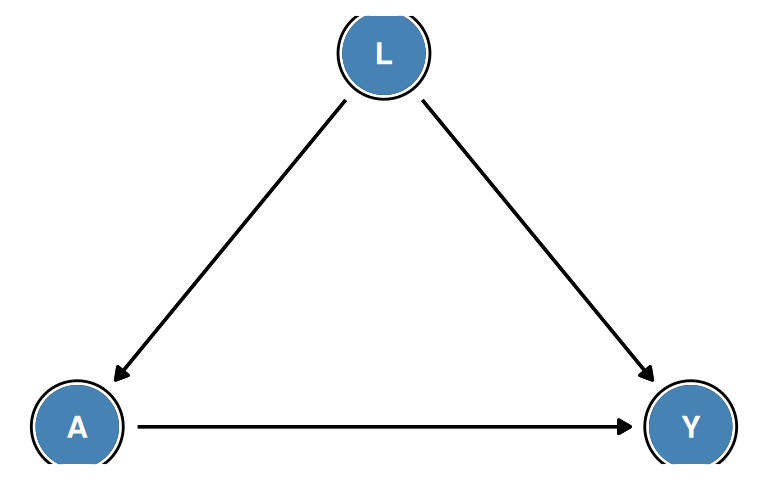
The path \(A \leftarrow L \rightarrow Y\) is a backdoor path from \(A\) to \(Y\). Because \(L\) is a non-collider on this path and has not been conditioned on, the path is open. Confounding bias exists whenever at least one backdoor path from \(A\) to \(Y\) is open.
Definition 1 (Confounding (Structural Definition)) Confounding of the effect of \(A\) on \(Y\) is present when the observed (crude) association between \(A\) and \(Y\) differs from the causal effect of \(A\) on \(Y\):
\[\Pr[Y = 1 \mid A = 1] - \Pr[Y = 1 \mid A = 0] \neq \Pr[Y^{a=1} = 1] - \Pr[Y^{a=0} = 1]\]
In structural terms, confounding exists when there is at least one open backdoor path from \(A\) to \(Y\) in the causal diagram.
Multiple DAG Structures
Different causal structures imply different sets of variables that satisfy the backdoor criterion.
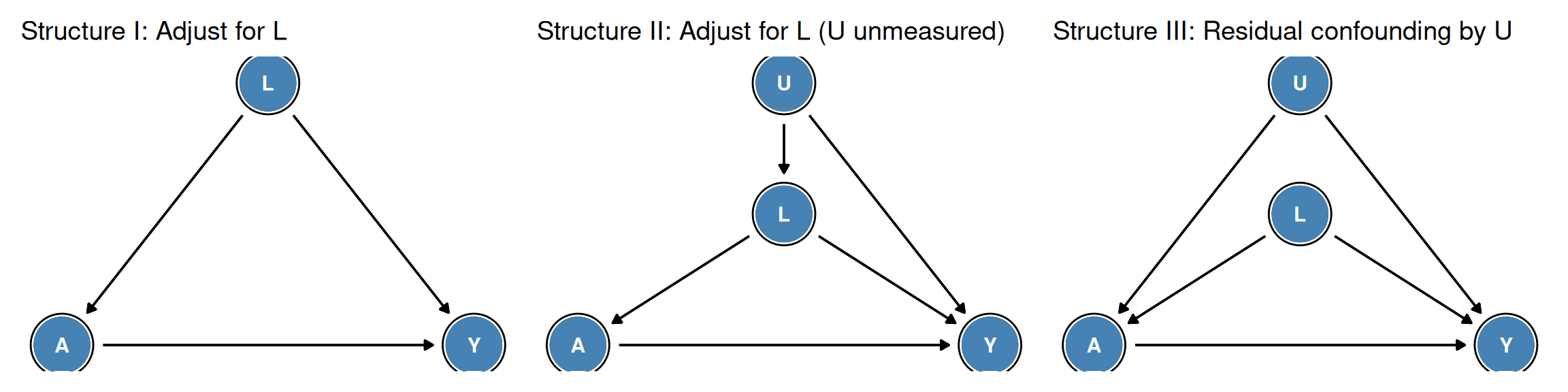
Structure I (\(L \to A\), \(L \to Y\), \(A \to Y\)):
- Backdoor path: \(A \leftarrow L \to Y\)
- \(\{L\}\) satisfies the backdoor criterion: \(L\) is not a descendant of \(A\) and blocks the only backdoor path.
- Adjustment for \(L\) suffices.
Structure II (\(U \to L \to A\), \(U \to Y\), \(L \to Y\), \(A \to Y\), \(U\) unmeasured):
- Backdoor paths: \(A \leftarrow L \to Y\) and \(A \leftarrow L \leftarrow U \to Y\)
- \(L\) is a non-collider on both paths; conditioning on \(L\) blocks them both.
- \(\{L\}\) satisfies the backdoor criterion: adjustment for \(L\) suffices even though \(U\) is unmeasured.
Structure III (\(U \to A\), \(U \to Y\), \(L \to A\), \(L \to Y\), \(A \to Y\), \(U\) unmeasured):
- Backdoor paths: \(A \leftarrow L \to Y\) and \(A \leftarrow U \to Y\)
- Conditioning on \(L\) blocks \(A \leftarrow L \to Y\), but the path \(A \leftarrow U \to Y\) does not pass through \(L\)—conditioning on \(L\) leaves it open.
- \(\{L\}\) does not satisfy the backdoor criterion because not all backdoor paths are blocked.
- Since \(U\) is unmeasured, no measured adjustment set can block \(A \leftarrow U \to Y\). The causal effect is not identified by adjustment alone.
When No Sufficient Adjustment Set Exists
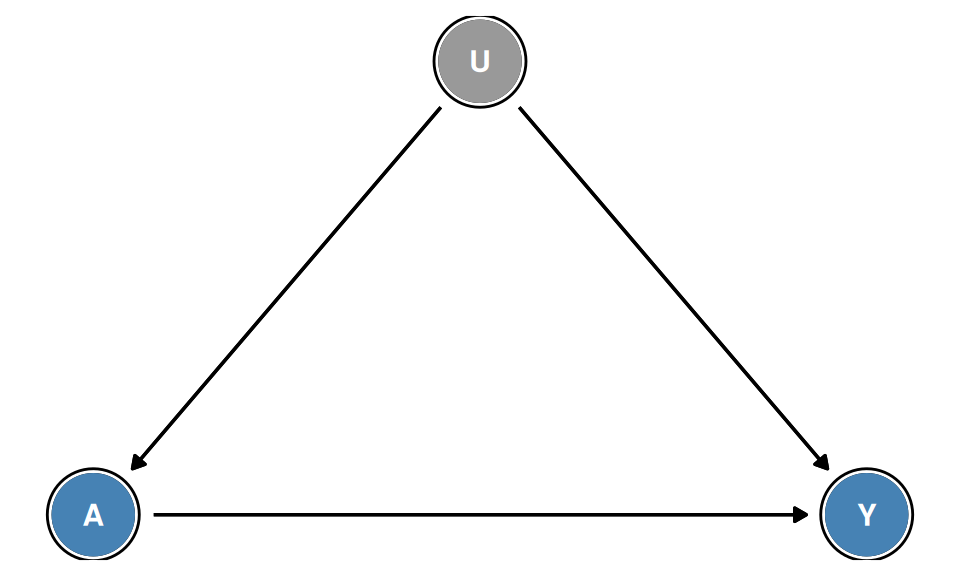
When the only common cause of \(A\) and \(Y\) is an unmeasured variable \(U\) (shown in gray), there is no measured set that satisfies the backdoor criterion. Standard adjustment methods cannot identify the causal effect without additional assumptions (e.g., instrumental variables, Chapter 16).
Fine Point 7.1: Do Not Adjust for Descendants of Treatment
A fundamental rule for constructing valid adjustment sets is: never include a descendant of treatment \(A\) in the adjustment set.
Why not? There are two distinct ways that adjusting for a post-treatment variable \(C\) (a descendant of \(A\)) can introduce bias:
Blocking part of the causal effect: If \(A \to C \to Y\) (so \(C\) is a mediator), conditioning on \(C\) removes part of the causal effect we are trying to estimate. We would estimate only the direct effect \(A \to Y\), not the total effect through \(C\).
Collider stratification bias: If \(A \to C \leftarrow U\) and \(U \to Y\) (so \(C\) is a collider on the path \(A \to C \leftarrow U \to Y\)), conditioning on \(C\) opens this previously blocked path and introduces a spurious association between \(A\) and \(Y\) via \(U\), even if \(U\) is unmeasured.
The second scenario is particularly insidious because the bias may not be obvious without drawing the causal diagram. The practical implication: when selecting variables to include in the adjustment set, first verify using the causal diagram that no candidate variable is a descendant of \(A\).
Limitations of the Traditional Criteria
The traditional criteria have two important limitations:
Problem 1: A variable can satisfy all three criteria without being a structural confounder.
If \(C\) is a collider on a non-causal path between \(A\) and \(Y\) (e.g., \(A \to C \leftarrow Y\)), then \(C\) may be associated with both \(A\) and \(Y\) in some data sets yet is not on any backdoor path. Including \(C\) in the adjustment set could introduce collider stratification bias rather than removing confounding.
Problem 2: A structural confounder may fail one of the traditional criteria.
A variable \(L\) that opens a backdoor path from \(A\) to \(Y\) might fail criterion 1 (not associated with \(A\) in the data) if its effects on \(A\) and \(Y\) cancel in a specific population. In that population, adjusting for \(L\) is still required to eliminate structural confounding, but the traditional criteria would not flag it as a confounder.
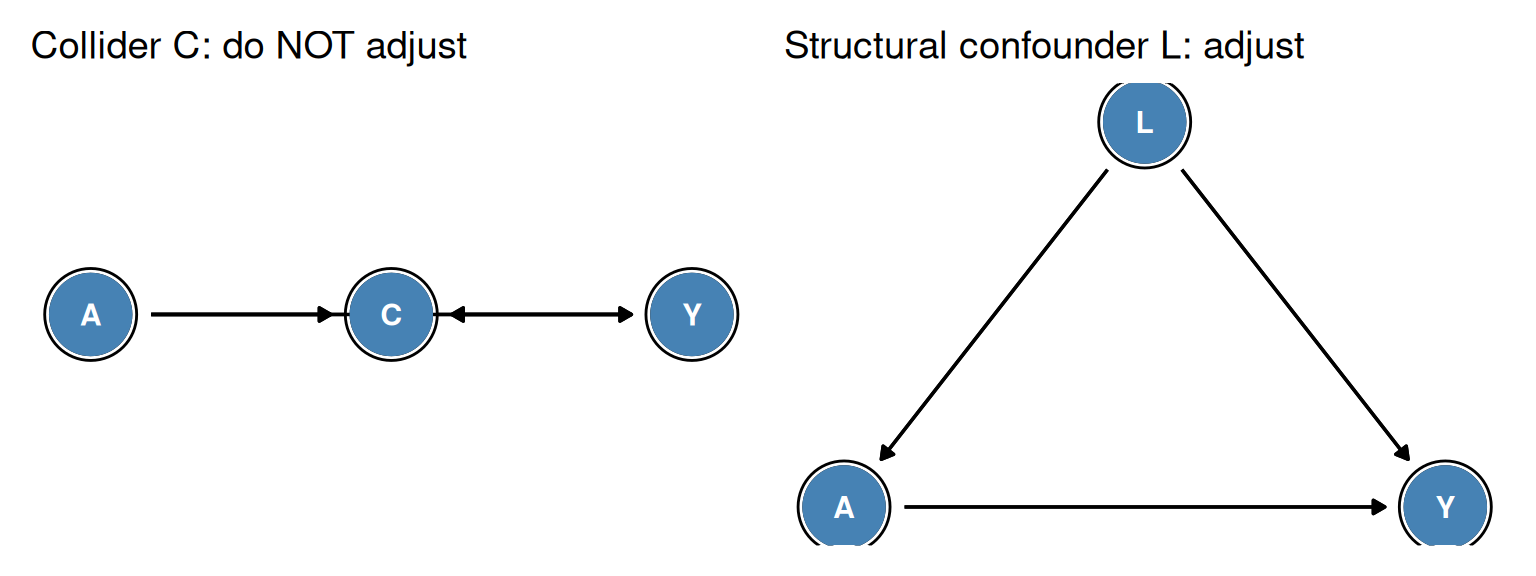
Definition 3 (Structural Confounder vs. Traditional Confounder) A variable \(L\) is a structural confounder of the effect of \(A\) on \(Y\) if it opens at least one backdoor path from \(A\) to \(Y\) in the causal diagram. The structural definition depends on the causal structure, not on observed associations.
The traditional epidemiological definition of confounder depends on observed associations (criteria 1 and 2) and may disagree with the structural definition in specific populations.
Best practice: Use the causal diagram (DAG) to identify the structural confounders and the appropriate adjustment set via the backdoor criterion.
Fine Point 7.2: Limitations of Association-Based Confounder Criteria
The traditional association-based criteria for confounding are population-dependent: a variable \(L\) may satisfy criteria 1 and 2 in one population but not in another, even though the causal structure is identical. This means the decision about whether \(L\) is a “confounder” depends on the study population, not on the underlying causal mechanism.
In contrast, the structural (DAG-based) definition is population-independent: if \(L\) opens a backdoor path in the causal diagram, it is a structural confounder regardless of the population distribution.
This distinction has practical implications. When planning a study, one should identify the structural confounders using subject-matter knowledge and causal diagrams—not by testing associations in the current dataset. Adjusting for structural confounders is necessary to eliminate confounding bias across all populations satisfying the assumed causal structure.